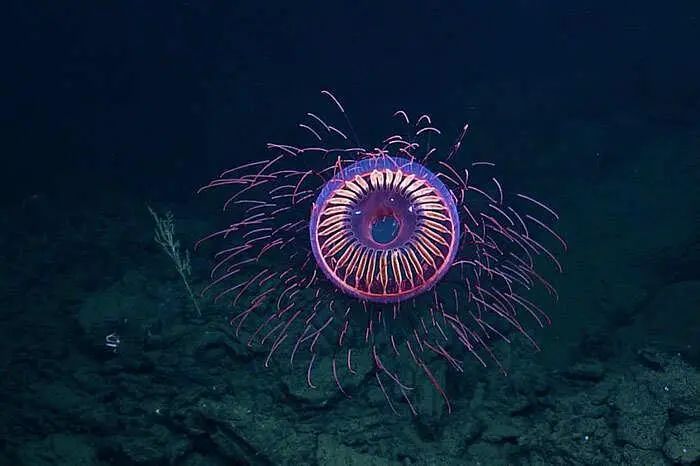
The Fireworks Jellyfish: Deep-Sea Marvel Illuminating 1,200–1,500 Meters Below the Surface


Marine Biology
The Fireworks Jellyfish: Deep-Sea Marvel Illuminating 1,200–1,500 Meters Below the Surface

Discovered in the pitch-black abyssal zone, the fireworks jellyfish (Halitrephes maasi) earns its name from its spectacular bioluminescent display—vibrant orange and pink tentacles that explode like celestial pyrotechnics in the ocean’s darkest depths. Thriving between 1,200 and 1,500 meters, this gelatinous creature has captivated marine biologists with its otherworldly appearance and mysterious life cycle.


A Living Explosion in the Abyss: Anatomy and Adaptations

  • Bioluminescence as a Survival Tool
    The jellyfish features a bell-shaped body up to 15 cm in diameter, ringed by long, branching tentacles coated in photophores—organs that emit bright orange and pink light. This glow, triggered by chemical reactions, serves dual purposes: attracting prey (such as small crustaceans) and confusing predators. The light patterns mimic the disorienting effect of a fireworks show, allowing the jellyfish to escape or ambush.
  • Structure for Extreme Pressure
    Its gelatinous body is adapted to withstand the crushing pressure of the deep sea, with a transparent bell that reduces drag as it drifts. Unlike shallow-water jellyfish, it lacks a prominent mouth, instead absorbing nutrients through its tentacles, which are covered in sticky cells to capture plankton.

Life in the Lightless Depths

  • Feeding and Locomotion
    The fireworks jellyfish floats slowly, using gentle pulsations of its bell to move. Its tentacles trail behind, spread wide to intercept passing prey. When threatened, it can retract its tentacles and increase its bioluminescent glow, potentially signaling to larger predators to deter attackers.
  • Rarity and Research Challenges
    Due to its deep-sea habitat, the species is rarely observed, with most sightings coming from remotely operated vehicles (ROVs). Scientists believe it reproduces sexually, releasing eggs and sperm into the water, but details about its lifecycle remain unknown. Its distribution is thought to be global in temperate and tropical oceans, though confirmed sightings are limited to the Pacific and Atlantic.

Ecological Significance and Conservation

While the fireworks jellyfish’s exact role in deep-sea ecosystems is unclear, it serves as a vital food source for larger abyssal creatures like grenadiers and gulper eels. Its bioluminescence also contributes to the "twilight zone" of the ocean, where light signals are crucial for communication and survival.


As deep-sea mining and climate change threaten these fragile ecosystems, the fireworks jellyfish stands as a symbol of the ocean’s undiscovered wonders. Its ephemeral glow reminds humanity of the urgent need to protect the abyss—where life evolves in ways that challenge imagination, and every flash of light holds secrets yet to be uncovered.

Latest Stories
Industry News1 minute readSamsung Electronics has officially launched its new foldable smartphones, the Galaxy Z Fold 7 and Z Flip 7, with pre-orders now fully open. The most notable upgrade in this iteration is the significantly slimmer body, which offers improved portability and has won widespread praise from early reviewers. However, this engineering breakthrough has also pushed up product costs and repair risks.
Sports News1 minute readAdditional details emerged Monday on the 2028 Los Angeles Olympics’ sport and venue schedule. The first events will start July 12—days before the opening ceremony—with team sports like cricket (Pomona Fairplex), handball (Long Beach Arena), and field hockey (Dignity Health Sports Park) kicking off at 9 a.m. local time. More early soccer prelims may be added later.
Entertainment News1 minute readGerman actress Paula Beer, now Christian Petzold’s go-to leading lady after succeeding Nina Hoss, continues to prove her talent in his latest work The Third Movement of the Mirror. The film premieres in the Directors’ Fortnight, adding to their acclaimed collaborations.
Beauty News2 minute readRome-based amateur model Sofia Romano, 28, takes center stage in Issue 177, with a series of posed yet natural photos capturing her in the Eternal City’s everyday scenes. Shot by local photographer Marco Bellini, the collection features Romano in carefully crafted poses—on her apartment balcony draped with bougainvillea, outside a centuries-old bookstore, and amid the vibrant stalls of Campo de’ Fiori market—each frame blending intentionality with the city’s timeless charm.
Industry News2 minute readDuring the early trading session on July 9, NVIDIA's stock surged nearly 2.8% to $164.42 (approximately ¥1,178.58), briefly pushing its total market capitalization beyond $4 trillion. This milestone makes NVIDIA the first company globally to achieve this feat. Currently, only three companies exceed $3 trillion in valuation: Microsoft ranks second at $3.75 trillion, followed by Apple at $3.14 trillion
Social News1 minute readFrederick Baur invented the potato chip can in 1966, a design that allowed chips to be neatly stacked. Proud of his creation, he requested before his death that his ashes be placed in one of his own cans.
Industry News1 minute readSouth Korea's retail sector showed signs of recovery in May, with offline sales returning to growth after a four-month slump, driven by strong demand for high-value products, data from the Ministry of Trade, Industry and Energy revealed on Wednesday.