The Bubble Alga: Nature’s Giant Single-Celled Marvel Floating in Tropical Seas


Marine Biology
The Bubble Alga: Nature’s Giant Single-Celled Marvel Floating in Tropical Seas

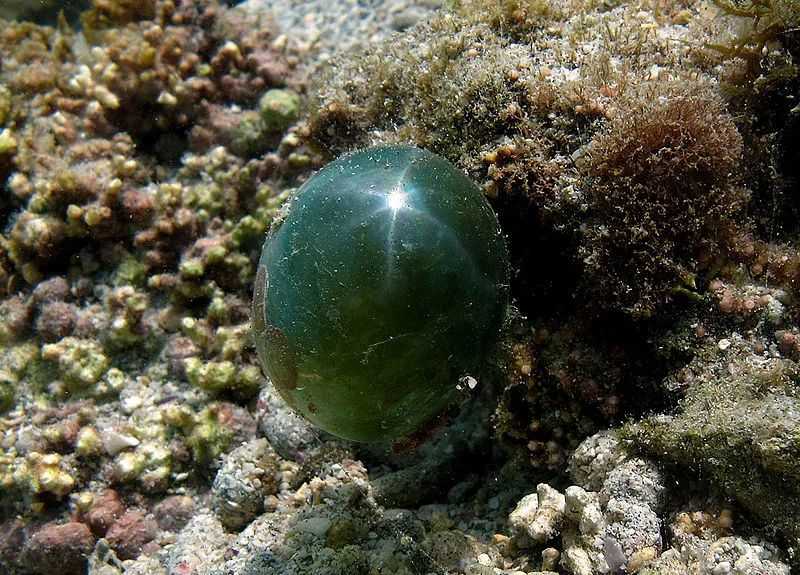
Known as the "bubble alga" or "sailor’s eyeball," Valonia ventricosa is a remarkable marine alga and one of the largest single-celled organisms on Earth. Thriving in tropical and subtropical oceans, this spherical green alga has fascinated biologists for its unique structure—each "bubble" is a single cell that can grow up to 5 centimeters in diameter, defying conventional notions of cellular size.


A Single Cell as a Living Sphere: Anatomy and Adaptations

  • Giant Unicellular Wonder
    Unlike most single cells visible only under a microscope, Valonia ventricosa forms hollow, rubbery spheres with a bright green chloroplast-laden cytoplasm lining the cell wall. The interior is filled with a watery sap, maintaining turgor pressure to sustain the bubble’s shape. This extraordinary size is achieved through nuclear division without cell division, resulting in a coenocytic structure (multiple nuclei within a single cell membrane).
  • Photosynthetic Strategy
    Living in shallow, sunlit waters, the alga uses chlorophyll to perform photosynthesis, converting sunlight into energy. Its spherical shape maximizes light absorption, while the thick cell wall protects it from herbivores like sea urchins and fish. When disturbed, the bubbles may release a sticky mucilage, deterring predators.

Ecology and Life in the Coral Reefs

  • Habitat and Distribution
    Found in clear, warm waters from the Indian Ocean to the Caribbean, Valonia ventricosa attaches to reefs, rocks, or seagrass beds using fine rhizoids (root-like structures). It prefers areas with moderate wave action, which provides nutrients and prevents sediment buildup.
  • Role in Marine Ecosystems
    As a primary producer, the bubble alga contributes to oxygen production and serves as a habitat for tiny invertebrates seeking shelter within its folds. Its decomposing cells release nutrients into the water, supporting coral reef health. However, under certain conditions (e.g., nutrient runoff), it can form dense mats, outcompeting other algae and disrupting local ecosystems.

Scientific Significance and Human Interaction

  • Cell Biology in the Extreme
    Valonia ventricosa is a model organism for studying cell physiology, as its large size allows researchers to easily manipulate and observe cellular processes. Studies on its membrane transport and osmotic regulation have shed light on how single cells maintain homeostasis.
  • Marine Ornament and Conservation
    In the aquarium trade, bubble algae are prized for their unique appearance but require careful maintenance to prevent overgrowth. In the wild, they face threats from coral bleaching, ocean acidification, and human disturbance. Their presence in a reef is often an indicator of water quality, making them valuable ecological sentinels.


With its spherical form floating in sunlit seas, Valonia ventricosa challenges our understanding of life at the cellular level. This "sailor’s eyeball" reminds us that in nature, even the simplest forms can achieve extraordinary feats—proving that size and complexity are not always synonymous, and that a single cell can hold the beauty and resilience of an entire organism.
Latest Stories
Beauty News1 minute readVienna-based amateur model Lina Weiss, 30, stars in Issue 176 with a series of posed photos that blend everyday life with subtle styling. Shot by photographer Leo Braun, the collection captures Weiss in her favorite local spots—from her backyard garden to a historic bakery and her apartment’s kitchen—each pose carefully arranged to feel natural, not forced.
Industry News1 minute readThe Office of the United States Trade Representative (USTR) announced the initiation of a Section 301 investigation into Brazil. The probe will examine whether Brazil’s policies and practices in areas such as digital trade, electronic payment services, "unfair" preferential tariffs, intellectual property protection, ethanol market access, and deforestation-related measures negatively impact U.S. trade interests.
Sports News2 minute readThe LA28 Organising Committee has formally published the detailed full schedule for the 2028 Summer Paralympics. The Games will cover 23 sports and 560 medal events, with competition running for more than 1,100 hours in total. Two sporting disciplines will kick off preliminary matches ahead of the Opening Ceremony, marking a historic scheduling arrangement for the Paralympic Movement.
Travel News2 minute readPerched at the meeting point of the Rhône and Saône rivers in Lyon, France, the Musée des Confluences stands as a beacon of innovative design and interdisciplinary storytelling. Crafted by Austrian architects COOP HIMMELB(L)AU and inaugurated in December 2014, this landmark institution has reshaped Lyon’s cultural landscape, merging avant-garde architecture with profound explorations of humanity’s place in nature and history.
Sports News1 minute readWorld Aquatics has informed TASS that Russian and Belarusian athletes competing under a neutral status are prohibited from linking their participation in events to their respective countries. This ban extends to social media, where posting flag emojis is not allowed, the organization announced this week.
Industry News1 minute readNetflix has revealed that it employed generative AI tools to create a building collapse sequence in the Argentine sci-fi series "The Eternals," which premiered on April 30, 2025. This marks the first time the streaming giant has used a generative AI-generated final shot in its original content, according to co-CEO Ted Sarandos.
Social News1 minute readSyria, a land steeped in ancient history, is the birthplace of Babylonian civilization, Mesopotamian culture, the Assyrian Empire, and the Phoenician Kingdom. Yet today, much of it lies in ruins, a casualty of prolonged conflict.