Perched atop a rocky outcrop in the natural pass between France’s Vosges and Jura Mountains, the Citadelle de Belfort stands as a testament to five centuries of military history. Revered as the "Gateway to France," this fortress is not only one of Europe’s best-preserved 17th-century defensive structures but also a paragon of strategic engineering that continues to awe visitors and scholars alike.
Perched atop a rocky outcrop in the natural pass between France’s Vosges and Jura Mountains, the Citadelle de Belfort stands as a testament to five centuries of military history. Revered as the "Gateway to France," this fortress is not only one of Europe’s best-preserved 17th-century defensive structures but also a paragon of strategic engineering that continues to awe visitors and scholars alike.
The Citadelle’s origins trace back to the Middle Ages, but its transformation into a military masterpiece began in the 17th century. In 1687, French military genius Vauban recognized its strategic significance, declaring it "the key to Eastern Europe." Over eight years, he redesigned it into a star-shaped citadel with bastions, barracks, and hidden casemates, embodying his "Second System" of fortification. In the 19th century, General Haxo added innovations like the Casemate 18 and prism-shaped towers, creating a fortress capable of deflecting artillery fire while maintaining cross-sectional defensive coverage. This blend of offense and defense remains a blueprint for military architecture.
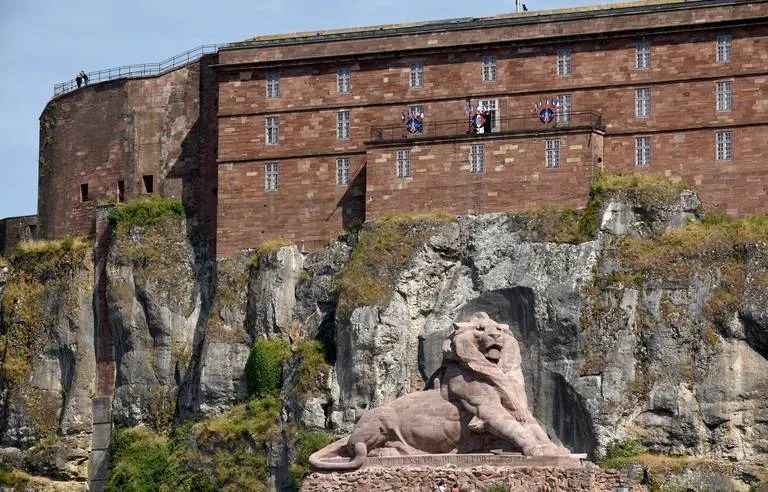
The Citadelle’s history is intertwined with France’s destiny. During the 1870 Franco-Prussian War, it withstood a 104-day siege, becoming a beacon of resistance amid France’s defeat. To commemorate this feat, sculptor Auguste Bartholdi crafted the Lion de Belfort – a 22-meter-long symbol of French resilience, its paws crushing broken chains. During WWII, integrated into the Maginot Line, its tunnels and arsenals provided vital strategic support, even as battles raged elsewhere.
Today, the Citadelle seamlessly blends history with modernity. Vauban’s star-shaped walls, a UNESCO-listed site, offer panoramic views of the Vosges. The Fort Hatry, once a military stronghold, has been reimagined as a vibrant public park with playgrounds, circus performances, and contemporary glass architecture that contrasts strikingly with ancient stone walls. Annually, the Eurockéennes Festival – one of Europe’s largest rock events – draws over 127,500 visitors, transforming the fortress into a stage of musical jubilation.
The Citadelle’s engineering brilliance endures. Its pentagonal layout ensures 360-degree defense, while hidden tunnels enabled rapid troop deployment. The inclined design of Casemate 18 dissipated cannonball impacts, a revolutionary concept at the time. These innovations influenced global fortifications, including West Point’s design during America’s Revolutionary War.
The Citadelle de Belfort transcends its military past, embodying the resilience of Alsatian culture. A living museum, it invites travelers to traverse centuries of history, from medieval ramparts to modern festivals, offering an unforgettable journey through France’s storied heritage.