EU May Withdraw Digital Tax Plan, Easing Pressure on U.S. Tech Giants


Industry News
EU May Withdraw Digital Tax Plan, Easing Pressure on U.S. Tech Giants

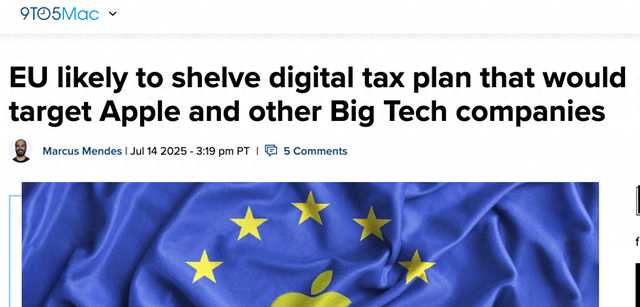
Foreign media reported on July 15 that the European Commission has formally withdrawn its plan to impose a digital tax on major tech companies during the latest budget negotiations. The decision is seen as a key compromise in EU-U.S. trade talks, temporarily relieving U.S. tech giants like Apple and Meta from heavy tax pressures, while the EU paves the way for broader trade agreements by adjusting its fiscal strategy.


Following the news, Apple’s stock rose 1.2% in pre-market trading, and Meta gained 1.8%. Dan Ives, an analyst at investment firm Wedbush, noted: “The EU’s concession removes one of the biggest regulatory risks for the tech industry. Leading companies are expected to accelerate investments in AI and cloud computing in Europe.”


It is learned that the EU will instead raise 25 billion to 30 billion euros annually to repay pandemic debts through new taxes, including a tiered tax on large enterprises with annual turnover exceeding 50 million euros operating in the EU, as well as an electronic waste disposal fee.


This shift reflects the EU’s prioritization of trade cooperation over unilateral tax policies. By shelving the digital tax, it avoids potential retaliatory measures from the U.S., which had previously opposed the plan citing unfair treatment of its tech firms.


The move also adjusts the EU’s revenue structure. While the digital tax was aimed at taxing tech giants’ digital services, the new taxes cover a wider range of enterprises, balancing fiscal needs with efforts to maintain a business-friendly environment for tech investment.

Latest Stories
Industry News1 minute readSamsung Electronics has officially launched its new foldable smartphones, the Galaxy Z Fold 7 and Z Flip 7, with pre-orders now fully open. The most notable upgrade in this iteration is the significantly slimmer body, which offers improved portability and has won widespread praise from early reviewers. However, this engineering breakthrough has also pushed up product costs and repair risks.
Sports News1 minute readAdditional details emerged Monday on the 2028 Los Angeles Olympics’ sport and venue schedule. The first events will start July 12—days before the opening ceremony—with team sports like cricket (Pomona Fairplex), handball (Long Beach Arena), and field hockey (Dignity Health Sports Park) kicking off at 9 a.m. local time. More early soccer prelims may be added later.
Entertainment News1 minute readGerman actress Paula Beer, now Christian Petzold’s go-to leading lady after succeeding Nina Hoss, continues to prove her talent in his latest work The Third Movement of the Mirror. The film premieres in the Directors’ Fortnight, adding to their acclaimed collaborations.
Beauty News2 minute readRome-based amateur model Sofia Romano, 28, takes center stage in Issue 177, with a series of posed yet natural photos capturing her in the Eternal City’s everyday scenes. Shot by local photographer Marco Bellini, the collection features Romano in carefully crafted poses—on her apartment balcony draped with bougainvillea, outside a centuries-old bookstore, and amid the vibrant stalls of Campo de’ Fiori market—each frame blending intentionality with the city’s timeless charm.
Industry News2 minute readDuring the early trading session on July 9, NVIDIA's stock surged nearly 2.8% to $164.42 (approximately ¥1,178.58), briefly pushing its total market capitalization beyond $4 trillion. This milestone makes NVIDIA the first company globally to achieve this feat. Currently, only three companies exceed $3 trillion in valuation: Microsoft ranks second at $3.75 trillion, followed by Apple at $3.14 trillion
Social News1 minute readFrederick Baur invented the potato chip can in 1966, a design that allowed chips to be neatly stacked. Proud of his creation, he requested before his death that his ashes be placed in one of his own cans.
Industry News1 minute readSouth Korea's retail sector showed signs of recovery in May, with offline sales returning to growth after a four-month slump, driven by strong demand for high-value products, data from the Ministry of Trade, Industry and Energy revealed on Wednesday.