The Quirky Boxfish: A Living Underwater Cartoon in Tropical Reefs


Marine Biology
The Quirky Boxfish: A Living Underwater Cartoon in Tropical Reefs

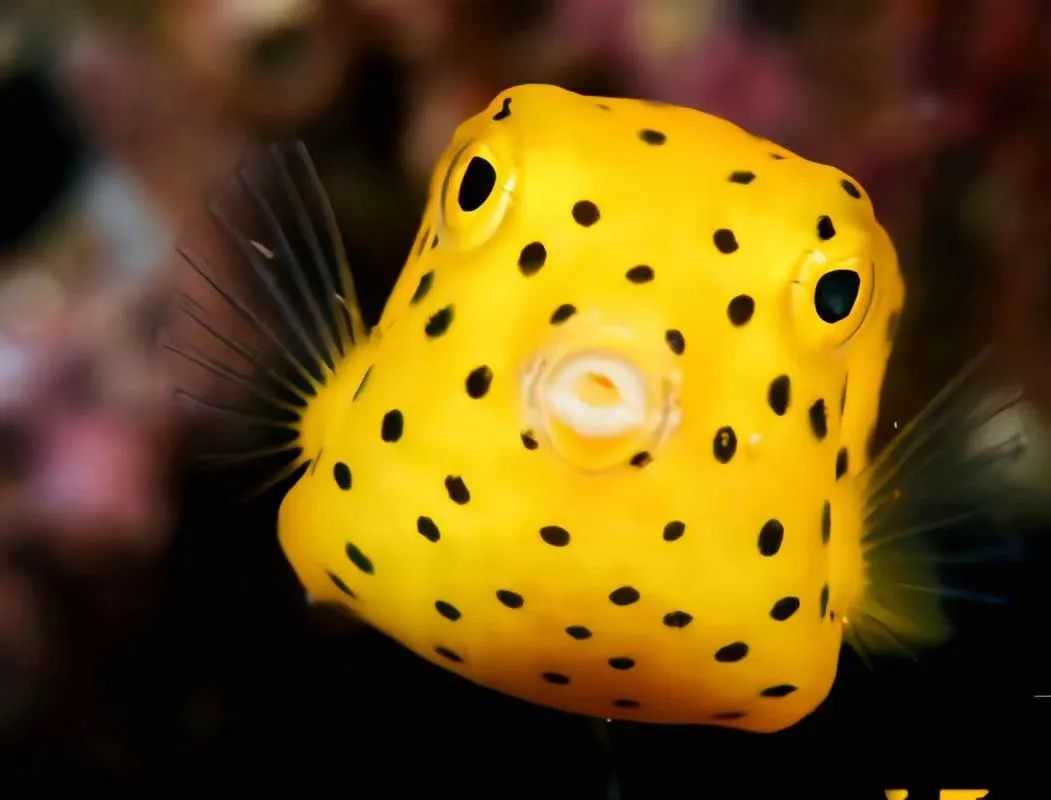
In the vibrant coral reefs of the Indian and Pacific Oceans, the Ostracion cubicus, or "papaya fish," adds a splash of whimsy to the marine world. Growing between 10 to 25 centimeters in length, this tropical inhabitant dwells among coral formations, munching on algae and small invertebrates. Its unique appearance makes it stand out like a character from an animated film.


Shaped like a tiny cube, the boxfish’s body is a striking canvas of bright yellow adorned with bold black spots. Its large, round eyes protrude comically from either side of its "box," giving it a perpetually curious expression. Adding to its charm is a small, forward-facing mouth that resembles a permanent pout, as if it’s blowing a kiss to onlookers. This combination of geometric form and vivid colors makes it one of the reef’s most recognizable and endearing residents.


Despite its adorable demeanor, the boxfish has a clever defense mechanism: when threatened, it secretes a toxic substance from its skin that deters predators. This adaptation, coupled with its bony, armor-like scales, ensures survival in a world teeming with predators. While it swims slowly and clumsily, using small fins to maneuver, its leisurely pace only adds to its cartoonish appeal. Divers and marine enthusiasts alike are drawn to its playful presence, which serves as a reminder of the ocean’s endless capacity for beauty and whimsy—even in the smallest, most unexpected forms.

Latest Stories
Beauty News1 minute readVienna-based amateur model Lina Weiss, 30, stars in Issue 176 with a series of posed photos that blend everyday life with subtle styling. Shot by photographer Leo Braun, the collection captures Weiss in her favorite local spots—from her backyard garden to a historic bakery and her apartment’s kitchen—each pose carefully arranged to feel natural, not forced.
Industry News1 minute readThe Office of the United States Trade Representative (USTR) announced the initiation of a Section 301 investigation into Brazil. The probe will examine whether Brazil’s policies and practices in areas such as digital trade, electronic payment services, "unfair" preferential tariffs, intellectual property protection, ethanol market access, and deforestation-related measures negatively impact U.S. trade interests.
Sports News2 minute readThe LA28 Organising Committee has formally published the detailed full schedule for the 2028 Summer Paralympics. The Games will cover 23 sports and 560 medal events, with competition running for more than 1,100 hours in total. Two sporting disciplines will kick off preliminary matches ahead of the Opening Ceremony, marking a historic scheduling arrangement for the Paralympic Movement.
Travel News2 minute readPerched at the meeting point of the Rhône and Saône rivers in Lyon, France, the Musée des Confluences stands as a beacon of innovative design and interdisciplinary storytelling. Crafted by Austrian architects COOP HIMMELB(L)AU and inaugurated in December 2014, this landmark institution has reshaped Lyon’s cultural landscape, merging avant-garde architecture with profound explorations of humanity’s place in nature and history.
Sports News1 minute readWorld Aquatics has informed TASS that Russian and Belarusian athletes competing under a neutral status are prohibited from linking their participation in events to their respective countries. This ban extends to social media, where posting flag emojis is not allowed, the organization announced this week.
Industry News1 minute readNetflix has revealed that it employed generative AI tools to create a building collapse sequence in the Argentine sci-fi series "The Eternals," which premiered on April 30, 2025. This marks the first time the streaming giant has used a generative AI-generated final shot in its original content, according to co-CEO Ted Sarandos.
Social News1 minute readSyria, a land steeped in ancient history, is the birthplace of Babylonian civilization, Mesopotamian culture, the Assyrian Empire, and the Phoenician Kingdom. Yet today, much of it lies in ruins, a casualty of prolonged conflict.