Mer de Glace: The Magnificent Giant in French Glaciers


Travel News
Mer de Glace: The Magnificent Giant in French Glaciers

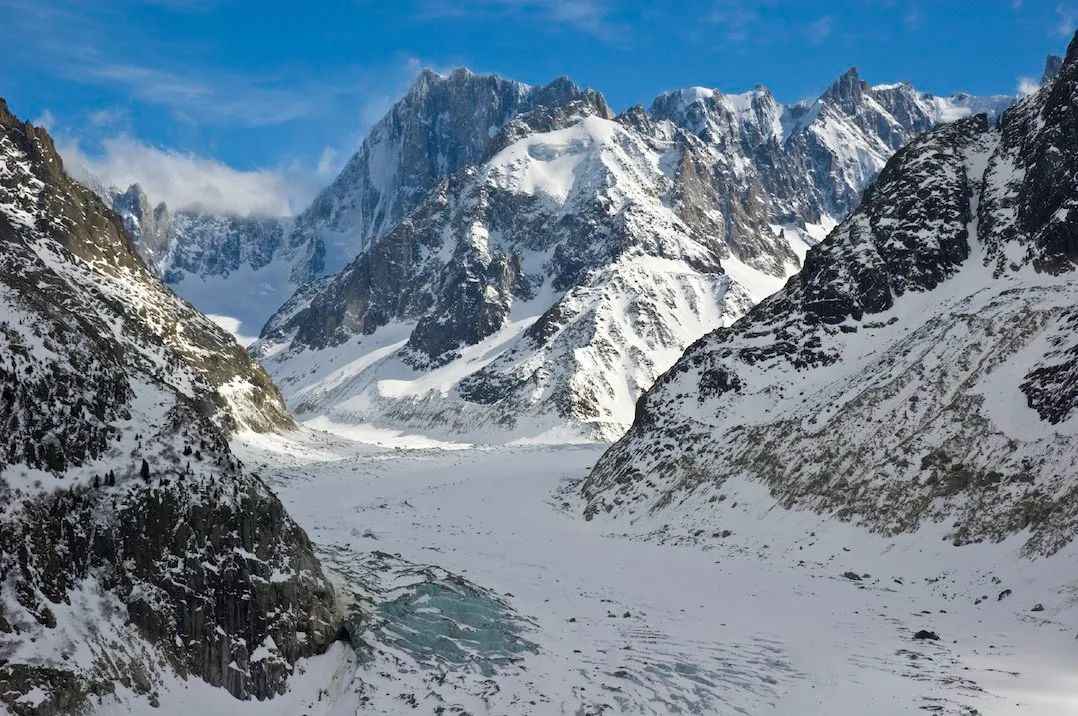
Mer de Glace, known as the largest glacier in France, is a remarkable natural wonder. Located in the Chamonix Valley of the Mont Blanc Massif, it stretches about 7 kilometers in length and reaches a depth of approximately 200 meters.

Mer de Glace, known as the largest glacier in France, is a remarkable natural wonder. Located in the Chamonix Valley of the Mont Blanc Massif, it stretches about 7 kilometers in length and reaches a depth of approximately 200 meters.


Formed by the confluence of several smaller glaciers, such as the Glacier de Lechaud and the Giant Glacier, Mer de Glace has been in a state of constant movement for a long time, with its upper part moving at a speed of nearly 120 meters per year. This glacier was discovered in 1741 by British explorers William Windham and Richard Pococke. Since then, it has attracted countless tourists and become one of the most popular natural scenic spots in France.


Visitors can take the Montenvers train to get close to this huge glacier, enjoying the spectacular view of the vast expanse of ice and snow along the way. There are also ice - caves carved in the glacier, where visitors can admire the exquisite ice sculptures. However, in recent years, affected by climate change, Mer de Glace has been retreating rapidly. It is melting at a speed of 40 meters per year, and its thickness has decreased by 80 meters in the past 20 years alone. This magnificent glacier is facing a severe test, reminding people to pay more attention to the impact of climate change on the ecological environment.

Latest Stories
Beauty News2 minute readBerlin-based amateur model Lena Schmidt, 26, takes the spotlight in Issue 174, with a series of posed yet natural photos capturing her in everyday Berlin settings. Shot by photographer Kai Berger, the collection balances intentionality and ease—Schmidt poses in her apartment’s sunlit kitchen, outside a historic bookstore, and along a tree-lined canal, each stance styled but never stiff.
Sports News1 minute readGermany is rethinking its elite sports model. A survey released this week by the German Olympic Sports Confederation (DOSB) shows that the public expects more from sports than just medals, calling for a national strategy centered on ethics, inclusivity, and social impact.
Sports News1 minute readWorld Aquatics has informed TASS that Russian and Belarusian athletes competing under a neutral status are prohibited from linking their participation in events to their respective countries. This ban extends to social media, where posting flag emojis is not allowed, the organization announced this week.
Travel News2 minute readNestled in France’s Haute-Savoie region, Chamonix stands as a legendary alpine sanctuary at the foot of Mont Blanc, Europe’s tallest peak. With its 4,808-meter summit piercing the clouds, this iconic mountain dominates the landscape, while the charming town below has cemented its status as a global mecca for winter sports and alpine adventure.
Cultural News1 minute readMost power outages in the U.S. are actually caused by squirrels, according to the American Public Power Association (APPA). The association has even developed a "Squirrel Index" system to track patterns of how squirrels impact electricity supplies.
Entertainment News1 minute readJenna Marie Ortega, born September 27, 2002, in Coachella Valley, California, has emerged as one of Hollywood’s most dynamic young talents. The Latina actress, known for her sharp performances and unapologetic authenticity, continues to redefine teen stardom.
Travel News2 minute readWarsaw's Old Town (Polish: Stare Miasto), the oldest district of Poland's capital, embodies a nation's phoenix-like resilience. In August 1944, Nazi forces systematically destroyed 85% of this 600-year-old city during the Warsaw Uprising, leaving only rubble and ashes . Yet, over two decades, the Polish people meticulously reconstructed it to its pre-war glory, earning its place on the UNESCO World Heritage List in 1980 as "an outstanding example of near-total reconstruction spanning the 13th to 20th centuries" .