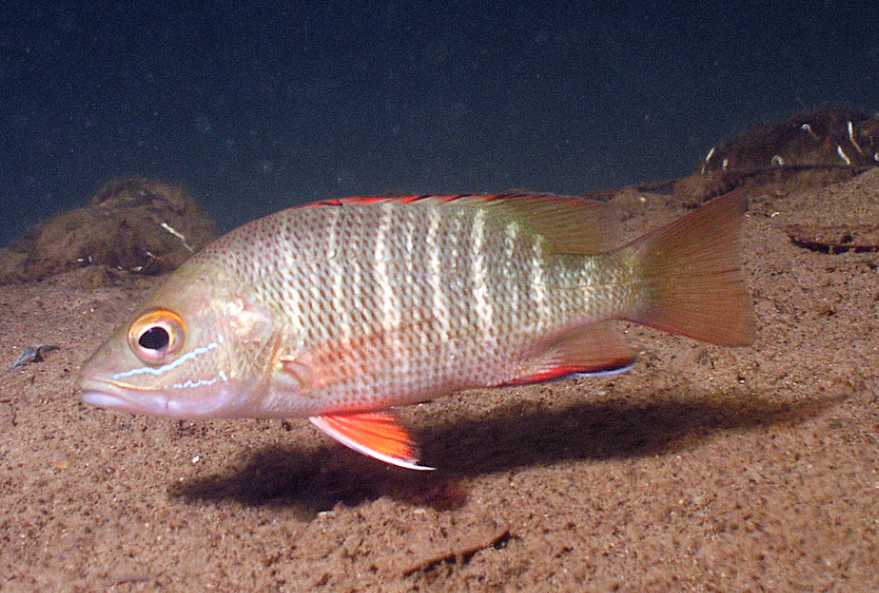
Lutjanus argentimaculatus: The Ruby Snapper of Tropical Shores


Marine Biology
Lutjanus argentimaculatus: The Ruby Snapper of Tropical Shores

Lutjanus argentimaculatus, commonly known as the ruby snapper, is a striking species within the Lutjanidae family, characterized by its elongated, laterally compressed body and vibrant coloration. Inhabiting the warm waters of the Indian Ocean and South Pacific, this fish features a distinct reddish-brown hue on its dorsal side, fading to a lighter shade on the abdomen. Juveniles display 7–8 silvery transverse bands along their flanks, which gradually disappear as they mature, giving way to a sleek, uniform adult appearance.

Reaching up to 120 centimeters in length, the ruby snapper prefers shallow coastal environments with sandy-muddy bottoms, shell beds, or rocky and coral reef structures at depths of up to 80 meters. Its range extends from the Indian Ocean to the South Pacific, including the South China Sea and the southern Taiwan Strait. As a demersal fish in tropical and subtropical waters, it undertakes short seasonal migrations in response to temperature and food availability, typically living a solitary or small-group lifestyle rather than forming large schools.


Primarily a benthic predator, Lutjanus argentimaculatus feeds on a diverse diet of crustaceans, mollusks, and small fish, utilizing its sharp teeth to capture prey from the seafloor. Its adaptability to various habitats makes it a key player in maintaining the balance of nearshore ecosystems. Commercially, the species is highly valued for its firm, white meat, supporting both artisanal and commercial fisheries across its range. However, it faces challenges from overfishing and habitat degradation, particularly from coastal development and destructive fishing practices that impact reef and sedimentary environments. While not currently listed as threatened, conservation measures such as marine protected areas and sustainable fishing regulations are essential to preserve this iconic snapper and the health of its tropical marine habitats.

Latest Stories
Industry News1 minute readSamsung Electronics has officially launched its new foldable smartphones, the Galaxy Z Fold 7 and Z Flip 7, with pre-orders now fully open. The most notable upgrade in this iteration is the significantly slimmer body, which offers improved portability and has won widespread praise from early reviewers. However, this engineering breakthrough has also pushed up product costs and repair risks.
Sports News1 minute readAdditional details emerged Monday on the 2028 Los Angeles Olympics’ sport and venue schedule. The first events will start July 12—days before the opening ceremony—with team sports like cricket (Pomona Fairplex), handball (Long Beach Arena), and field hockey (Dignity Health Sports Park) kicking off at 9 a.m. local time. More early soccer prelims may be added later.
Entertainment News1 minute readGerman actress Paula Beer, now Christian Petzold’s go-to leading lady after succeeding Nina Hoss, continues to prove her talent in his latest work The Third Movement of the Mirror. The film premieres in the Directors’ Fortnight, adding to their acclaimed collaborations.
Beauty News2 minute readRome-based amateur model Sofia Romano, 28, takes center stage in Issue 177, with a series of posed yet natural photos capturing her in the Eternal City’s everyday scenes. Shot by local photographer Marco Bellini, the collection features Romano in carefully crafted poses—on her apartment balcony draped with bougainvillea, outside a centuries-old bookstore, and amid the vibrant stalls of Campo de’ Fiori market—each frame blending intentionality with the city’s timeless charm.
Industry News2 minute readDuring the early trading session on July 9, NVIDIA's stock surged nearly 2.8% to $164.42 (approximately ¥1,178.58), briefly pushing its total market capitalization beyond $4 trillion. This milestone makes NVIDIA the first company globally to achieve this feat. Currently, only three companies exceed $3 trillion in valuation: Microsoft ranks second at $3.75 trillion, followed by Apple at $3.14 trillion
Social News1 minute readFrederick Baur invented the potato chip can in 1966, a design that allowed chips to be neatly stacked. Proud of his creation, he requested before his death that his ashes be placed in one of his own cans.
Industry News1 minute readSouth Korea's retail sector showed signs of recovery in May, with offline sales returning to growth after a four-month slump, driven by strong demand for high-value products, data from the Ministry of Trade, Industry and Energy revealed on Wednesday.