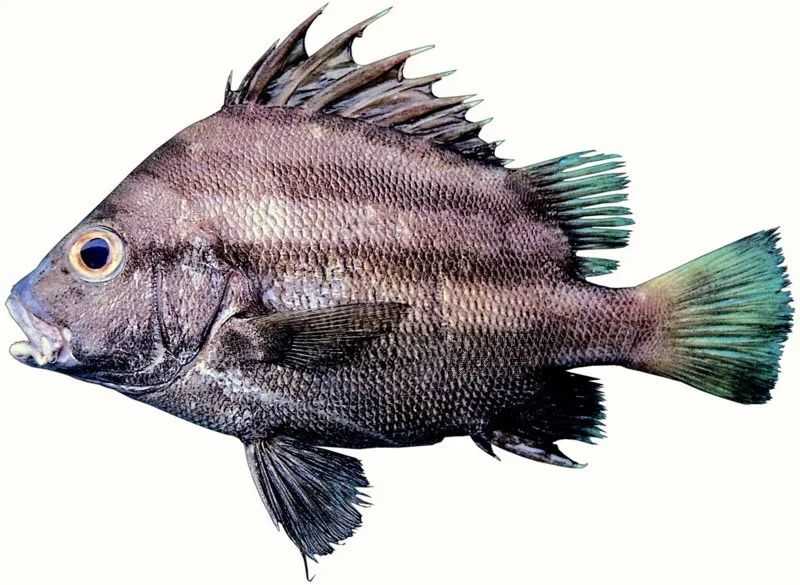
Hapalogenys mucronatus: The Oblique-Banded Beard Croaker of Asian Coastal Waters


Marine Biology
Hapalogenys mucronatus: The Oblique-Banded Beard Croaker of Asian Coastal Waters

Hapalogenys mucronatus, commonly known as the oblique-banded beard croaker, is a distinctive marine fish belonging to the Haemulidae family. Inhabiting the temperate and subtropical waters of the northwestern Pacific Ocean, this species is celebrated for its unique appearance and cultural significance in regional fisheries. Characterized by its robust body and striking diagonal stripes, it stands out as a notable inhabitant of coastal ecosystems.


Growing up to 40 centimeters in length, the oblique-banded beard croaker features a deep, laterally compressed body with a silvery-gray base color adorned by 5–6 dark, oblique bands that run from the dorsal fin to the ventral side, creating a bold, eye-catching pattern. Its most notable feature is the pair of small, bristle-like barbels near the corners of its mouth, which aid in detecting benthic prey such as crustaceans, mollusks, and small fish. The dorsal fin is divided into two parts: a spiny anterior section and a soft-rayed posterior section, while the caudal fin is slightly forked, enabling agile movement over sandy or rocky seabeds.


Primarily a demersal species, Hapalogenys mucronatus inhabits shallow coastal areas, including rocky reefs, estuaries, and the vicinity of jetties, at depths ranging from 10 to 60 meters. It is a solitary or small-group feeder, active during both day and night, using its barbels to probe the substrate for food. During the breeding season, typically in late spring to early summer, adults migrate to nearshore waters to spawn, releasing pelagic eggs that develop in the water column. Juveniles often seek shelter in seagrass beds or among artificial structures, gradually moving to deeper habitats as they mature.


Highly prized in regional cuisines for its tender, flavorful flesh, the oblique-banded beard croaker is a key species in commercial and recreational fisheries. However, its populations have declined due to overfishing, habitat degradation from coastal development, and pollution. Conservation efforts, such as the establishment of marine protected areas, seasonal fishing bans, and aquaculture initiatives, aim to sustainably manage its stocks. As a vital component of coastal marine ecosystems, Hapalogenys mucronatus underscores the need for balanced stewardship of marine resources to ensure its survival and the health of its habitat.

Latest Stories
Travel News1 minute readPerched atop a hill in the Burgundy region of France, the medieval town of Vézelay is home to the Basilica Sainte-Marie-Madeleine. This architectural masterpiece, blending Romanesque and Gothic styles, holds a pivotal place in history as the spiritual launchpad of the Second Crusade in 1147.
Industry News2 minute readThe Defense Counterintelligence and Security Agency (DCSA) on July 9 released its 2025-2030 IT Strategic Plan, outlining six core objectives to modernize defense cybersecurity, enhance data-driven decision-making, and foster collaboration with industry and academia. The initiative aims to create a secure digital ecosystem aligned with the Pentagon’s broader digital transformation goals, particularly supporting the Department of Defense’s (DoD) Chief Digital and AI Office (CDAO) in advancing AI integration and governance .
Beauty News1 minute readLisbon-based amateur model Sofia Reis, 24, takes center stage in Issue 172 of Life Photos of Foreign Beauties, with a series capturing her daily life in Portugal’s coastal capital. The unpolished yet charming shots, taken by local photographer Ana Costa, showcase Reis in moments of quiet routine—from walking her dog along the Tagus River to arranging fresh flowers in her apartment. Her 173cm frame, often clad in linen dresses and leather sandals, mirrors the city’s laid-back, sun-soaked energy.
Industry News1 minute readRecent leaked reports suggest that Apple's upcoming ultra-thin iPhone 17 Air will be equipped with a battery capacity of approximately 2,800 mAh, a figure that not only falls below the industry-standard 3,000 mAh threshold but also smaller than the battery capacities of all models in the current iPhone 16 series.
Travel News2 minute readNestled in the Saône-et-Loire department of Burgundy, France, the Abbey of Cluny (Abbaye de Cluny) stands as a testament to a millennium of history. Founded in 910 by William the Pious, Duke of Aquitaine, this Benedictine monastery was the spiritual and political epicenter of medieval Christendom. Its revolutionary "Cluniac Reforms" reshaped monastic life across Europe, emphasizing strict asceticism, autonomy from secular rule, and unwavering loyalty to the Pope, thereby revitalizing the Catholic Church.
Cultural News1 minute readTo encourage young people to donate blood, Sahlgrenska University Hospital in Gothenburg, Sweden, sends donors a text message when their donated blood is actually used. This lets them know their contribution has truly helped someone in need.
Industry News1 minute readThe Office of the United States Trade Representative (USTR) announced the initiation of a Section 301 investigation into Brazil. The probe will examine whether Brazil’s policies and practices in areas such as digital trade, electronic payment services, "unfair" preferential tariffs, intellectual property protection, ethanol market access, and deforestation-related measures negatively impact U.S. trade interests.