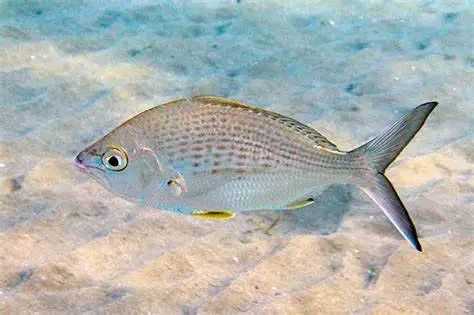
Gerres longirostris: The Long-Snouted Mojarra of Tropical Shores


Marine Biology
Gerres longirostris: The Long-Snouted Mojarra of Tropical Shores

Gerres longirostris, commonly known as the long-snouted mojarra or longnose jewelfish, is a distinctive species within the Gerreidae family, belonging to the order Perciformes. Inhabiting the warm, shallow waters of the Indo-Pacific region, this fish is characterized by its elongated snout and streamlined body, making it a unique and ecologically significant inhabitant of coastal and estuarine ecosystems.


Growing up to 25 centimeters in length, Gerres longirostris features a laterally compressed, silvery body with a pale golden or olive tint on its dorsal surface, fading to a bright silver on the ventral side. Its most defining trait is the elongated, pointed snout, which gives the species its name and aids in sifting through sandy substrates to locate prey. Large, reflective eyes and a small, protractile mouth adapted for bottom feeding allow it to efficiently capture small invertebrates, such as crustaceans, worms, and mollusks, buried in the sediment. The dorsal fin is divided into two parts: a spiny anterior section and a soft-rayed posterior section, with the first few spines slightly elongated in mature individuals.


Native to estuaries, lagoons, and sheltered coastal areas, the long-snouted mojarra thrives in waters less than 20 meters deep, often near mangrove forests, seagrass beds, or rocky outcrops. It is a schooling species, forming dense aggregations that move in synchronized patterns to forage or avoid predators. During the breeding season, typically in the warmer months, adults migrate to nearshore waters to spawn, releasing pelagic eggs that develop in the water column. Juveniles seek refuge in the protected habitats of mangrove roots or tidal flats, where they feed on plankton and small benthic organisms until they mature.


While not a primary target for large-scale commercial fisheries, Gerres longirostris holds local importance in artisanal fishing communities, valued for its delicate flesh and role in subsistence diets. However, it faces significant threats from habitat degradation, including mangrove deforestation, coastal pollution, and sedimentation from urban development. These activities disrupt the shallow-water ecosystems it relies on for feeding and reproduction. As a species that bridges the gap between marine and freshwater environments, it serves as an indicator of estuarine health. Conservation efforts focused on preserving mangrove habitats, promoting sustainable fishing practices, and reducing pollution are crucial to safeguarding this unique mojarra and the biodiverse ecosystems it inhabits. By protecting Gerres longirostris, we also support the resilience of coastal communities and the intricate web of life in tropical and subtropical waters.

Latest Stories
Beauty News1 minute readVienna-based amateur model Lina Weiss, 30, stars in Issue 176 with a series of posed photos that blend everyday life with subtle styling. Shot by photographer Leo Braun, the collection captures Weiss in her favorite local spots—from her backyard garden to a historic bakery and her apartment’s kitchen—each pose carefully arranged to feel natural, not forced.
Industry News1 minute readThe Office of the United States Trade Representative (USTR) announced the initiation of a Section 301 investigation into Brazil. The probe will examine whether Brazil’s policies and practices in areas such as digital trade, electronic payment services, "unfair" preferential tariffs, intellectual property protection, ethanol market access, and deforestation-related measures negatively impact U.S. trade interests.
Sports News2 minute readThe LA28 Organising Committee has formally published the detailed full schedule for the 2028 Summer Paralympics. The Games will cover 23 sports and 560 medal events, with competition running for more than 1,100 hours in total. Two sporting disciplines will kick off preliminary matches ahead of the Opening Ceremony, marking a historic scheduling arrangement for the Paralympic Movement.
Travel News2 minute readPerched at the meeting point of the Rhône and Saône rivers in Lyon, France, the Musée des Confluences stands as a beacon of innovative design and interdisciplinary storytelling. Crafted by Austrian architects COOP HIMMELB(L)AU and inaugurated in December 2014, this landmark institution has reshaped Lyon’s cultural landscape, merging avant-garde architecture with profound explorations of humanity’s place in nature and history.
Sports News1 minute readWorld Aquatics has informed TASS that Russian and Belarusian athletes competing under a neutral status are prohibited from linking their participation in events to their respective countries. This ban extends to social media, where posting flag emojis is not allowed, the organization announced this week.
Industry News1 minute readNetflix has revealed that it employed generative AI tools to create a building collapse sequence in the Argentine sci-fi series "The Eternals," which premiered on April 30, 2025. This marks the first time the streaming giant has used a generative AI-generated final shot in its original content, according to co-CEO Ted Sarandos.
Social News1 minute readSyria, a land steeped in ancient history, is the birthplace of Babylonian civilization, Mesopotamian culture, the Assyrian Empire, and the Phoenician Kingdom. Yet today, much of it lies in ruins, a casualty of prolonged conflict.